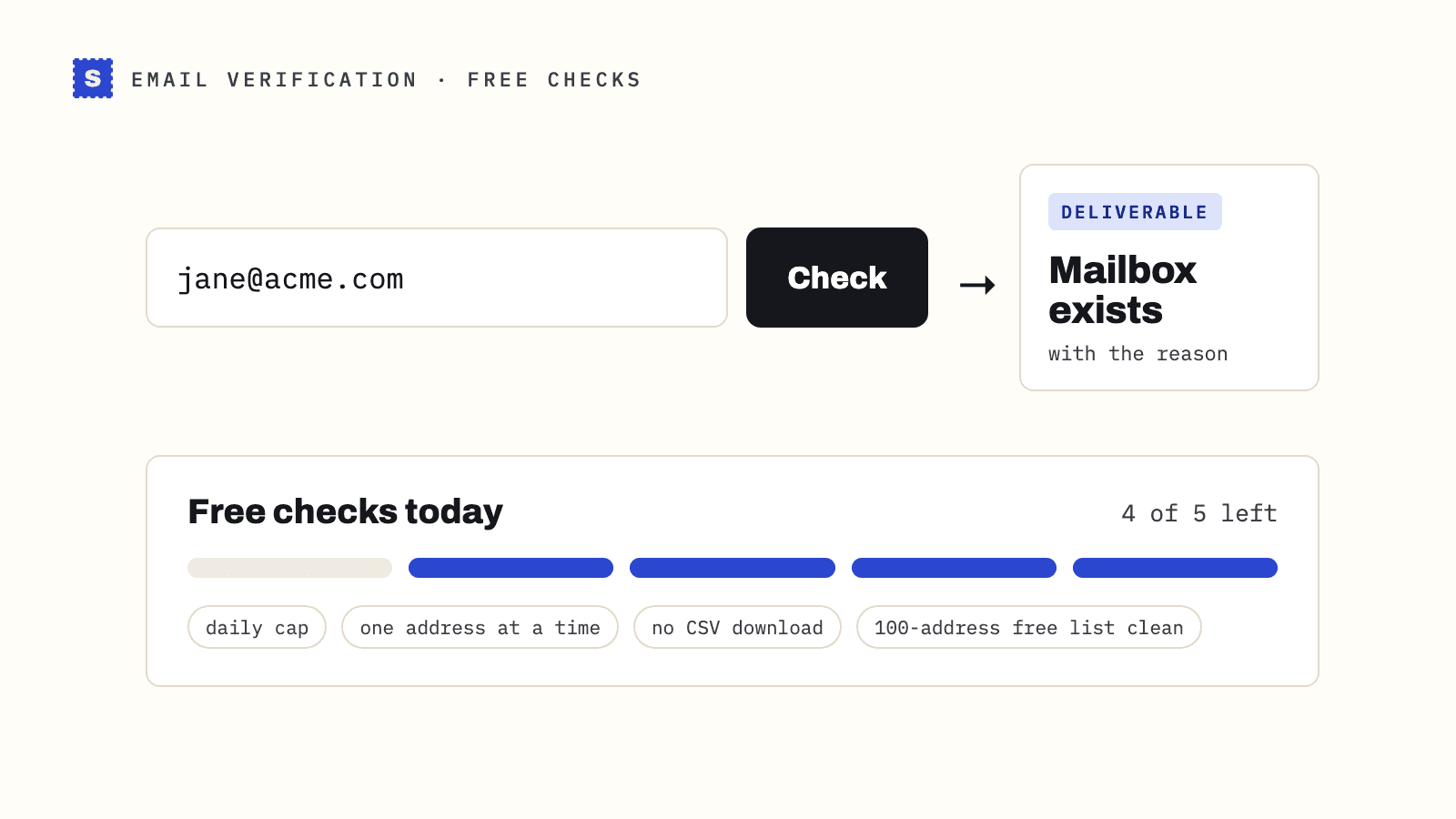
You can verify an email address for free. SimpleCold's email checker checks 5 addresses a day without an account, free list cleaning checks a pasted list of up to 100, and signing up adds 200 free credits with no card. Most paid verifiers have a similar free allowance, usually 100 to 250 checks. What differs is how deep the free check goes and what you're allowed to do with the results.
This post is about those differences. If you want the free methods that don't need any tool, such as looking up the domain's mail servers yourself, how to check if an email is valid covers them.
What a free email verifier should check
Not every "free email checker" is doing the same job. Some only look at the format. A useful one runs the same checks as a paid verification:
- Syntax. Is the address written correctly?
- Domain and mail servers. Does the domain exist, and does it publish MX records that accept mail?
- Disposable and role lists. Is it a throwaway inbox, or a shared address like
info@? - Typos. Is
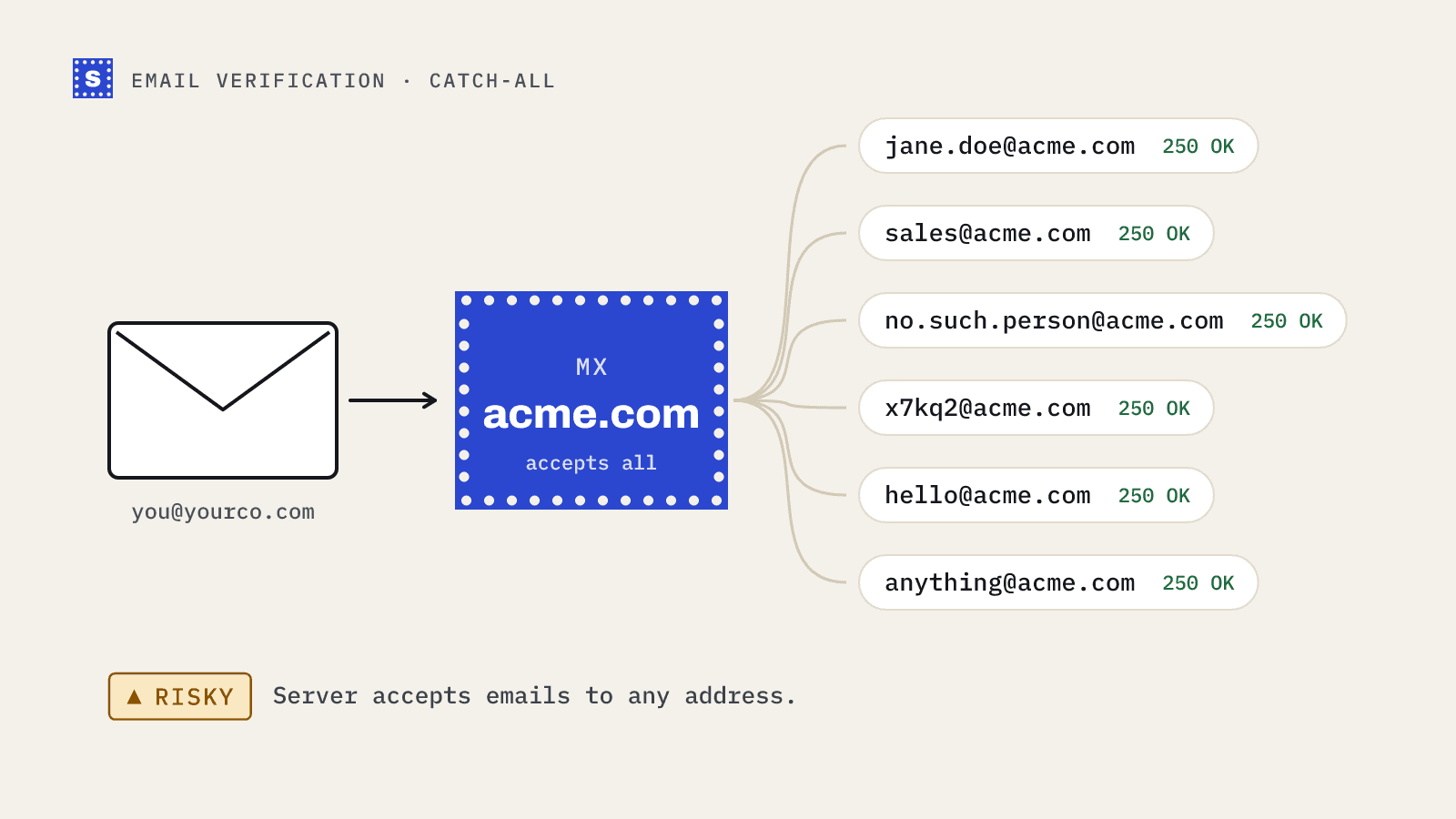
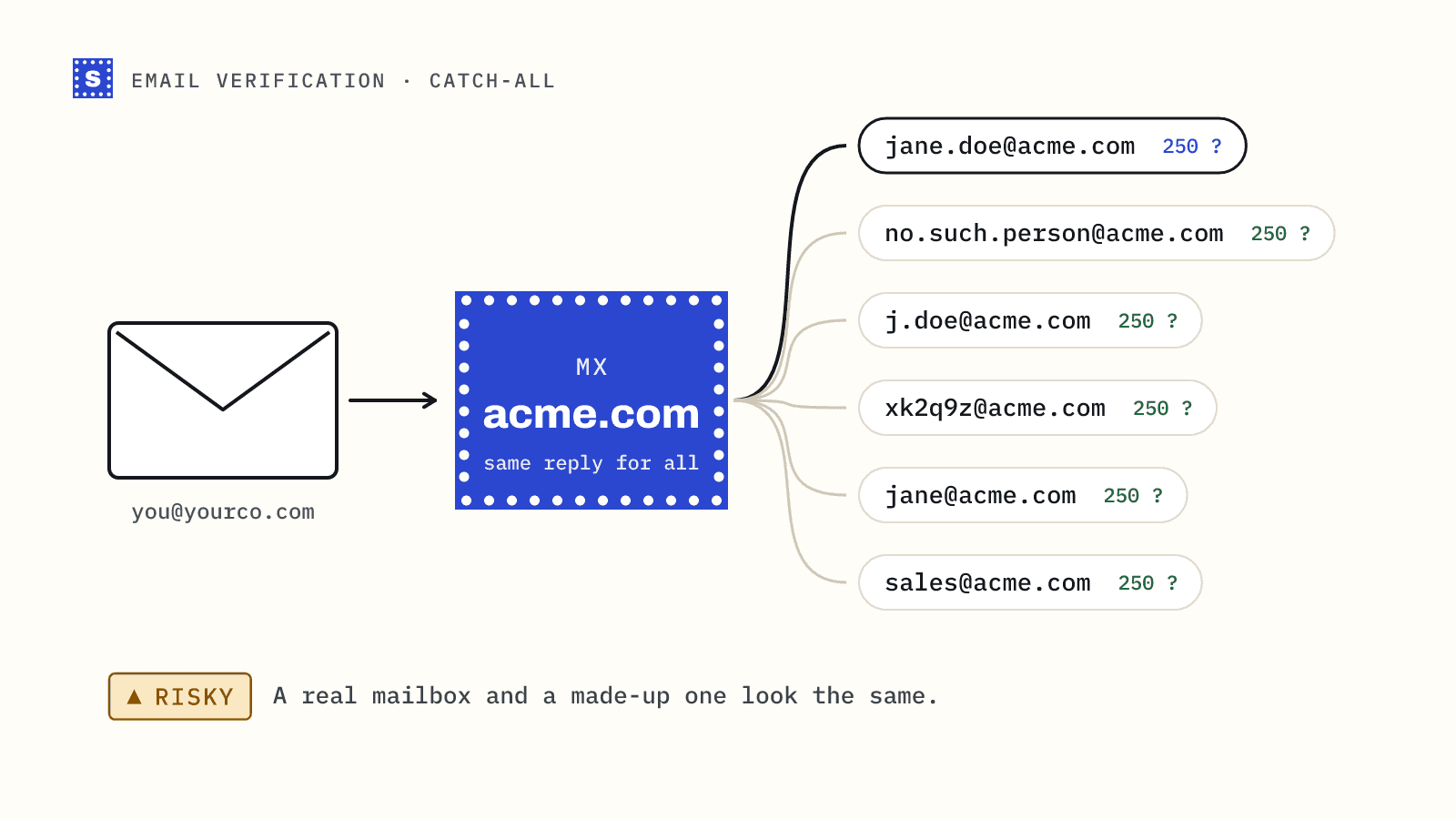
gmial.comreallygmail.com? - Catch-all. Does the domain accept mail for any address, so the mailbox can't be confirmed?
- The mailbox itself. Asked over SMTP, does the mail server accept this specific recipient? The check stops before anything is sent.
The last two are the expensive part, because they need a live conversation with the recipient's mail server. A checker that answers instantly every time, or never mentions catch-all, is probably skipping them. That kind of tool tells you an address could exist, not that it does. The difference is explained in email validation vs verification.
SimpleCold's free tools run all six checks, and the results are the same as the paid product.
How much you get free
Here's what each vendor's own pricing page offered when we checked on 26 October 2026:
| Verifier | Free allowance |
|---|---|
| SimpleCold | 5 checks a day without an account, one free list of up to 100 a day, and 200 credits on sign-up with no card |
| Emailable | 250 credits on sign-up |
| Reoon | 20 credits a day, plus 100 at sign-up |
| ZeroBounce | 100 credits a month on the freemium plan |
| Bouncer | 100 credits, no card |
| MillionVerifier | 100 credits, no card |
| Kickbox | 100 free verifications |
| Clearout | 100 credits at sign-up |
| DeBounce | 100 credits, one time |
| Hunter | 50 credits a month, up to 100 verifications |
Hunter's email verifier is part of its finding product, and its credits are shared with email finding: one verification costs half a credit. If you only need to verify, compare it against the others on that basis. Our SimpleCold vs Hunter page has the details.
None of these allowances is large enough to clean a real marketing list. They're enough to check a handful of addresses, or to test a tool on a sample before you pay.
The limits that catch people out
Free tiers are generous on the headline number and strict in the details. These are the ones worth knowing before you rely on one:
- Daily or monthly caps. A monthly allowance resets and doesn't roll over. A daily one is fine for a few checks, useless for a list.
- Human checks. Free checkers without an account have to stop bots from draining them. SimpleCold runs a quick, usually invisible, human check before each free check. Others use a captcha or ask for an email address first.
- No file download. Free list tools often let you copy the clean list but not download a CSV with your original columns. SimpleCold's free list cleaning works that way; uploading a CSV and keeping your columns needs an account.
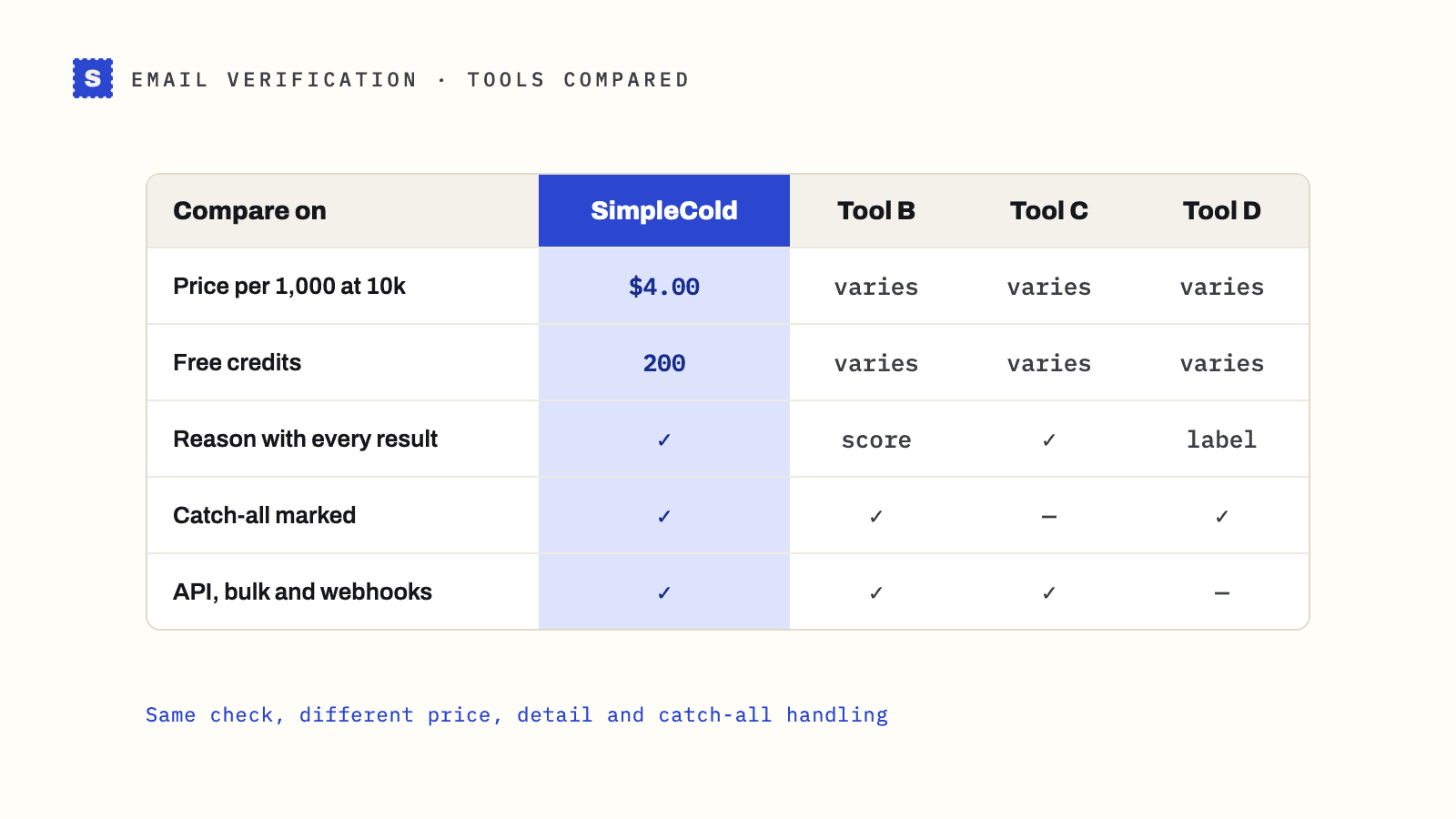
- No reason, only a label. "Invalid" or a score of 40 leaves you guessing. Look for a reason with every result, so you know whether you're looking at a dead mailbox or a server that wouldn't answer.
- Slow servers. Some mail servers answer slowly on purpose. A free checker that gives up quickly returns more "unknown" results. SimpleCold shows Processing and fills in the result when the server answers, usually within a minute or two, without using another free check.
- What happens to the data. You're pasting someone's personal data into a website. Check the privacy page. Ours says addresses and results go into a verification cache so a repeat check can reuse the answer.
Use a free check to judge a whole list
The most useful thing a free allowance can do isn't cleaning a list. It's telling you whether a list needs cleaning at all, before you spend anything.
- Take a random sample. Pull 100 addresses from across the list, not the first 100. Sorting by sign-up date or source and taking every Nth row works.
- Paste them into free list cleaning. Each comes back Deliverable, Risky or Undeliverable with a reason.
- Read the shape, not the exact numbers. If almost everything is Deliverable, the list is in good shape. If a noticeable share is Undeliverable, the full list will be similar, and sending to it unverified will produce hard bounces. A large Risky share with catch-all reasons is normal for B2B lists and needs its own plan.
- Decide. A list that looks clean and was emailed recently may only need suppression of past bounces. A list that's old, bought, scraped or never mailed should be verified in full before the first send.
A sample of 100 won't give you a precise bounce rate, but it's usually enough to tell a healthy list from a risky one. For what counts as a safe bounce rate, see email bounce rate benchmarks.
When free stops being enough
Free tools are the right choice for one-off checks: a lead someone forwarded, a customer who says they never got your email, a sign-up that looks fake. They stop being enough when:
- The list is bigger than the free cap. Verifying 5,000 addresses five at a time isn't realistic.
- You need the file back. Re-importing into a CRM or sequencer needs a CSV with the original columns and the result added. The bulk email verifier keeps every column.
- It needs to happen automatically. Sign-up forms and data pipelines need the email verification API, not a web page.
- You verify regularly. Cold outreach lists should be checked before every campaign. How often should you clean your email list has a schedule by list type.
At that point the cost is small compared with the cost of bounces. SimpleCold's credits start at 5,000 for $25 ($0.005 per check) and drop to $0.00125 at 500,000. There's no subscription, and credits don't expire. Duplicates in a CSV are checked and charged once. See pricing.
Free email checks without any tool
If you only have one address and don't want to use any service, you can still learn a lot by hand: look for typos, look up the domain's MX records with an MX lookup, and check the format with the email syntax checker. These catch dead domains and broken addresses, but they can't confirm a mailbox exists. For that you need a check against the mail server, which is what the free email checker does.